Follow the Digital Edge on Google
Table of content
Interesting topics
How to Rank on Page 1 of Google in South Africa
Every week someone contacts us wanting to be “number one on Google.”
It’s a reasonable thing to want and an unreasonable thing to promise. Anyone who guarantees you a number one position is either misunderstanding how Google works or hoping you do.
Here’s what actually moves the needle, roughly in the order it matters.
First: page 1 of what?
“Page 1 of Google” isn’t one thing anymore, and this distinction changes everything about your strategy.
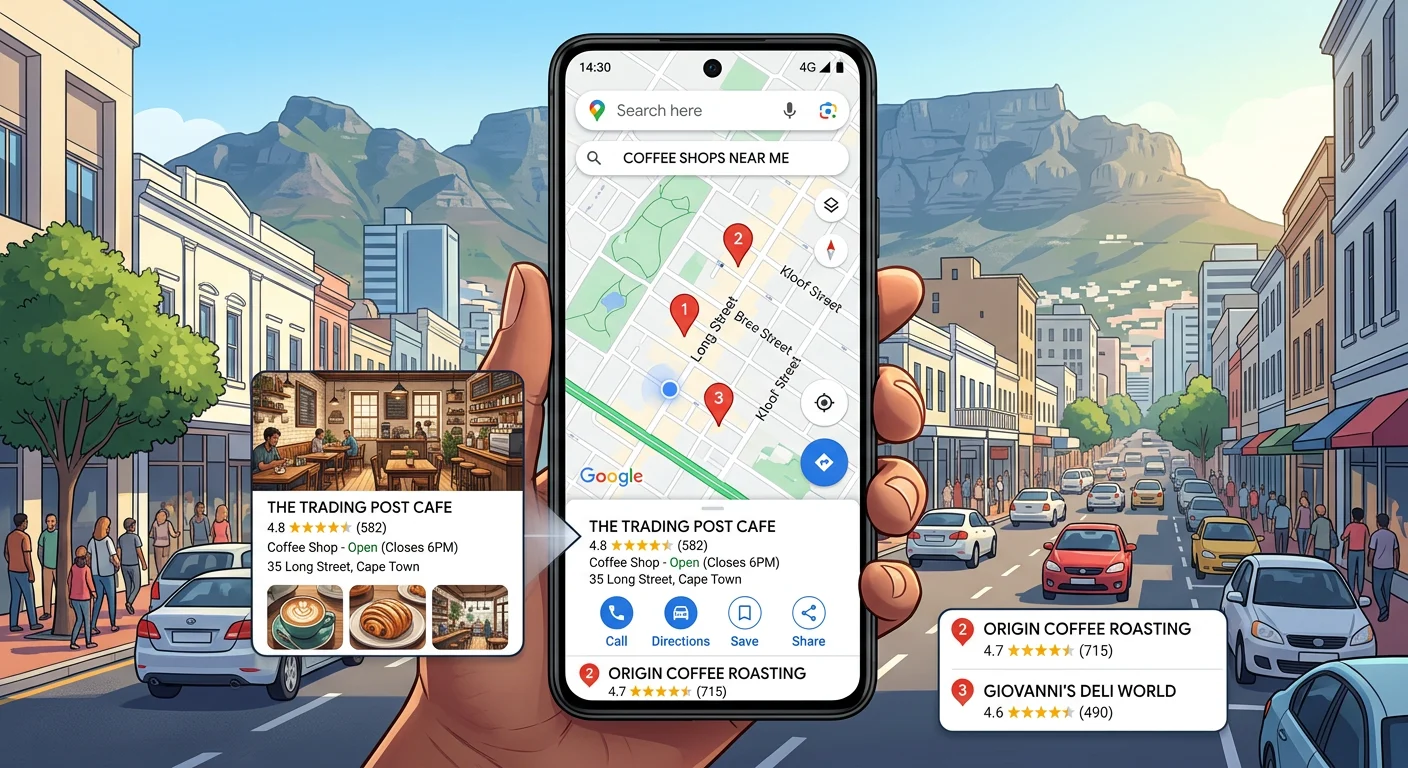
The map pack. The three local businesses shown with a map for searches like “plumber Bellville.” This is often the easiest and most valuable position for a South African service business — and it’s won almost entirely through your Google Business Profile, not your website.
Organic results. The traditional blue links. Slower to win, but durable once you’re there.
AI Overviews. Google’s generated answer at the top. Increasingly where the attention goes, and being cited here is a different game from ranking.
If you’re a local business, the map pack should be your first target. It’s faster to win than organic, it appears above organic results, and it’s where people ready to buy actually click.
Start with what you can control this week
Your Google Business Profile
If you’re a local business and you do nothing else on this list, do this properly.
- Claim and verify the profile
- Get your categories right — the primary category matters more than the rest combined
- Make sure your name, address and phone number match your website exactly
- Set accurate hours, including public holidays
- Add real photos, not stock images
- Post updates regularly
- Reply to every review, good and bad
Reviews are the lever most SA businesses under-use. A steady flow of recent reviews with genuine detail moves you in the map pack more reliably than almost anything you can do on your website. Ask every satisfied customer. Make it easy — send the direct link.
The basics on your site
Google can’t rank what it can’t understand.
- One clear topic per page. A page trying to cover plumbing, electrical work and paving ranks for none of them.
- Title tags that name the thing and the place. “Emergency Plumber in Somerset West | Business Name” beats “Home | Business Name.”
- Real content on service pages. Not 80 words of filler. Answer what the customer actually wants to know.
- Location on the page. If you serve George and the Garden Route, say so in the text, not just the footer.
- Working internal links between related pages.
Speed and mobile matter more here than elsewhere
This is a genuinely South African point.
A large share of your traffic is on mobile, often on data, sometimes on a mid-range Android device on a patchy connection. A site that loads acceptably on fibre in an office can be unusable on 3G in a car park.
Test with Google PageSpeed Insights on the mobile tab. The common culprits on WordPress sites:
- Enormous uncompressed images, by a wide margin the biggest offender
- Too many plugins doing too little
- Cheap oversold hosting with slow server response
- Heavy sliders and animations above the fold
Compressing your images and moving to decent hosting will do more for you than most “SEO packages” sold to small businesses.
Content is how you rank for more than your own name
Most small business websites have five pages and rank only for their business name. That’s not a ranking problem — there’s just nothing there to rank.
People search in questions: what does a website cost in South Africa, do I need a maintenance plan, how long does a bathroom renovation take. Every one of those is a page you could own.
Write for the question, not the keyword. Answer it directly, near the top, in plain language. Then give the detail.
Local specificity beats generic advice. A guide to pricing “in South Africa,” in rand, with local suppliers named, will out-rank and out-convert generic international content every time — because it’s actually useful to the person searching.
Consistency compounds. One post a month for two years beats twenty posts in one month and then silence. Google notices sites that are maintained.
The AI Overview angle
This is new enough that most SA competitors aren’t thinking about it.
Content that gets pulled into AI-generated answers tends to be structured clearly, answer questions directly, and include specific verifiable facts — real numbers, real prices, real requirements. Vague marketing prose doesn’t get cited because there’s nothing in it to cite.
Practical things that help:
- Clear headings that match real questions
- A direct answer immediately under each heading
- FAQ schema on pages with genuine question-and-answer content
- Specific figures rather than “affordable” and “competitive”
- Allowing AI crawlers in your robots.txt if you want to be cited
We’ve seen a well-structured post get picked up in an AI Overview within 48 hours of publishing. It’s not a slow game if the content is right.
What to ignore
Guaranteed rankings. Nobody controls Google’s index. A guarantee is a sales tactic.
Buying backlinks. A cheap package of hundreds of links from unrelated sites is a risk, not an asset.
Keyword stuffing. Repeating “web design Cape Town” thirty times reads badly to humans and does nothing for you.
Obsessing over one keyword. Most traffic comes from the long tail of specific questions, not from the single competitive term you fixated on.
Chasing a tool’s score. Green lights in an SEO plugin are a rough checklist, not a ranking. A page can score 100/100 and rank nowhere.
How long, and what does it cost?
Map pack, if your profile is neglected: often improvement within four to eight weeks.
Organic rankings for genuinely competitive terms: six to twelve months of consistent work. Anyone quoting faster is selling something.
Cost: meaningful ongoing SEO for a small SA business generally starts around R2,500–R6,000 a month. Below roughly R1,500 you’re usually buying a monthly report, not work.
You can do a lot of this yourself. The Google Business Profile work, review collection and basic content cost nothing but time, and they’re the highest-leverage items on the list.
Where to start on Monday
If this feels like a lot, do these five in order:
- Claim and complete your Google Business Profile properly
- Ask your last ten happy customers for a review
- Compress every image on your site
- Fix your title tags so they name the service and the place
- Write one page answering the question your customers ask most
That’s a week of work and it will out-perform most entry-level SEO retainers.
The bottom line
Ranking on page one in South Africa isn’t a trick. It’s a local profile handled properly, a site that loads fast on a phone, and content that answers real questions — repeated consistently for long enough that Google trusts you.
Slow, unglamorous, and it works.
Want an honest assessment of where your site stands? Get in touch for a free SEO audit — no obligation, no guaranteed-rankings nonsense.